Wednesday, September 7, 2016

Di-sexting Shakespeare


Tell me where is fancy bred,
Or in the heart or in the head?
How begot, how nourished?
Reply, reply.


At le pain quotidien.
Go with gut or gritty yen,
Stems mendel broth,
man's desire,
'Tis up t'you to tend fire.


***

I am quite fond of this reply I made to a girl's Shakespeare-quoting dating profile. I challenged her to find hidden meanings.

Synopsis of hidden meanings [spoileralert]:

Pain Quotidien is an upscale bakery.  It's a joke. But, also, "pain quotidien" means everyday bread, bread of the people. It evokes ritual and nourishment. But 'pain' in English means suffering - in this case, the suffering of the 'people' in much the way a communist uses the word 'proletariat'.

Gut. More bread jokes. And of course, trust your intuition. Gritty yen can be the friction of one's struggle to find meaning, but also a hint of the struggle to survive, since grit is toughness but also sometihng you might expect in poor people's bread (corn grits). Or it can be the despoilment of life through material pursuits - money - since yen is japanese currency.

Stems, plants. Mendel is considered the father of genetics. Broth being the primordial soup - growing things from a fertile source. But we are also sticking with the Panera/Bread Shop theme here. And for good measure, since life is all about patterns, there's an echo of Mandelbrot sets here, the mathematics which produce progressive infinite variations - commonly expressed visually as fractals, and used as a concrete example of how complexity can come (stem) from a simple set of rules. A rich life can come from living simply.

Man's desire? I'm driving home the genetics thing. We reproduce sexually.  So I'm also hitting on her. I want to fuck her.

Fire. She's hot, so let's get hot together. The source of desire can be found in modern gene-based evolutionary theory, but it's a sort of cop out to only explain how we are the way we are - what she really wants to know is what to do about it! So I give her a lead. My Stoke Quest is all about finding what fuels my own passions - tending to the fires of one's own ambition is an active cultivation., so I use the word fire in that sense of how he uses it in "The Road."

“You have to carry the fire."
I don't know how to."
Yes, you do."
Is the fire real? The fire?"
Yes it is."
Where is it? I don't know where it is."
Yes you do. It's inside you. It always was there. I can see it.”  - Cormack McCarthy

But I intentionally leave out the word 'to' - so tending fire can also mean to be fire, or to be inclined toward a life lived like a fire...

The only people for me are the mad ones, the ones who are mad to live, mad to talk, mad to be saved, desirous of everything at the same time, the ones who never yawn or say a commonplace thing, but burn, burn, burn, like fabulous yellow roman candles exploding like spiders across the stars and in the middle you see the blue centerlight pop and everybody goes “Awww! - Kerouac

And that's everything.  I'd love for someone to pull more meanings out, tough!

Saturday, August 8, 2015

Major Tom

  • She asked, "What have you to fear?" He took a deep breath. 

  • "Nothing but fear itself. And fear of failing to measure equal to the tasks before me."
  • With only her mind, she reached to him.

  • "Like the whole damn city's a blaze and everyone's mad, laughing, cheering, dancing, but that's just the way it goes... Something along those lines?

  • Mmm, no task is so important, I hope you know. But I think you already do. 

  • Tell me, if you were to fail, at your tasks, or anything for that matter, who are you letting down?"
  • He replied with a wry self-aware chuckle.

  • "Don't you know? I'm out to save the world."

Friday, July 24, 2015

The Secret Behind ol' Necessity and Ma Invention

Necessity is the mother of invention, but necessity and invention have raised a terrifying grandchild: Consumption.

The word conjures images of old-time diseases, but believe me - it's happening right now. If you are reading this right now, you're a consumer. I'm a consumer. Most of this earth is being consumed by a unthinking, unfeeling, nigh-unstoppable force of Consumption for Consumption's sake. It's going to kill us.  I quote Brower and McPhee:

Compare the six days of the book of Genesis 
To the four billion years of geologic time
On this scale, one day equals about 666 million years.
All day Monday, until Tuesday noon, 
Creation was busy getting the Earth going.
Life began on Tuesday noon,
And the beautiful organic wholeness of it 
developed over the next four days.
At 4 PM Saturday the big reptiles came;
Five hours later, when the redwoods appeared, 
there were no more big reptiles.

At three minutes before midnight, man appeared.
At one-fourth of a second before midnight, Christ revolted.
At one-fortieth of a second before midnight, the Industrial Revolution began.

We are surrounded by people who think 
that what we have been doing 
for one-fortieth of a second 
can go on indefinitely.
They are considered normal.
But they are Stark. Raving. Mad.

This is the danger of Consumption.  To carry the metaphor, Capitalism and Addiction have fathered Consumption, but they take no responsibility for controlling their children. Only Necessity and Invention can stop us now.

"We cannot solve our problems with the same thinking we used when we created them." - Albert Einstein

So, dear reader, we're faced with a dire abstraction, so what?  Well, as the 2016 presidential election begins coming to a boil this year, more and more candidates are being quoted on the 'issues'. A lot of millennials are posting about the economy, about the lack of jobs, about student debt and shrinking opportunities, about distrust for power. Even Mike Rowe of Dirty Jobs is telling people to skip a University Degree and go into a trade. And a shocking thing was mentioned on a friend's facebook, a Jeb Bush paraphrase- "Let's work harder to get ourselves out of this rut." 

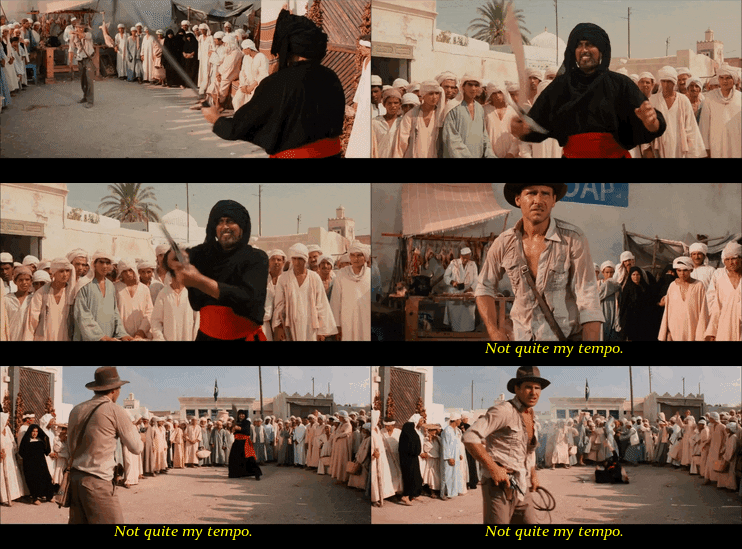
There's a classic scene in Indiana Jones where Indiana faces an increasingly frenetic series of attackers, culminating in a swashbuckling sword expert. As the two daunting foes face off, Indiana is so exhausted, he simply pulls a revolver and shoots his attacker.


In real life Harrison Ford was actually crippled with an intestinal bug and was supposed to go through another impressive series of fight scenes.  Necessity truly is the mother of invention, but how do we balance perseverance with thoughtfulness in the quest to solve our big issues?  What do we do when hard work simply isn't enough?


Tell me, reader. Is work really the answer?


So I posted the following reply to the goal of  "4 percent growth as far as the eye can see...  a lot more productive, workforce participation has to rise ... people need to work longer hours and through their productivity gain more income for their families":

Respectfully, I must make an impassioned plea. This is super retro thinking. We now live in an information-based economic system where the real crises are distribution of wealth and responsible growth, and creating citizens who have the tools to solve the most pressing and complex social problems. We are no longer a manufacturing economy, where more material goods equals greater prosperity. The only way we can compete with hungrier centers of manufacturing, with India and China, is to automate - which means fewer jobs, not more. Yvon Chouinard talks of how we need more thinkers, how we need to learn to be happy with less, not more, and how a craft economy (think Etsy, think farmer's markets) will have to evolve in order to employ the large part of the population who are superfluous to survival. We work ourselves to death on a mouse's wheel - but if we realigned our goals to focus on healthcare, education, food and happiness - then we could all work a hell of lot less, not more. The protestant work ethic is damning us all.

I hope the reader is acquainted with Sisyphus. 


This poor soul who, being too cunning for his own good,
was famed as the craftiest of all men, and even deemed
himself craftier than the gods, tricking them too.  

The gods eventually caught up with Sisyphus, dooming him to an eternity of rolling a boulder uphill, only to see his efforts wasted at the last moment. So it is that the laws of physics will eventually catch up with man in our thirst to suck life out of nature.  So it is that the greatest prosperity is not remotely synonymous with the greatest satisfaction - and as our wealth increases happiness remains only inches out of reach.

"The first principle is that you must not fool yourself and 
you are the easiest person to fool." - Richard P. Feynman

Can we stop to think of the huge advancements which have been gifted to our generation?  The technology of the 18th, 19th, 20th and 21st centuries are surely godlike powers.  We have sanitation, running water, more than enough food, books, electricity, movies, medicines, fossil fuels, the might of industrial power and the knowledge of the internet with the swift justice of machine learning algorithms and the awesome communication of social media.  Maybe we are more like Prometheus, another Greek legend - clever enough to steal fire but not ready for the consequences of a global economy: death by vanity, global warming and drug resistant mega-infection.  

And I am painfully aware that much of the gifts heaped upon me are pearls to swine. I realize that even a tiny fraction of my wealth could so improve the human condition of so many and yet I am numb to it.

Bill Nye talks about the root to global success being the education of poor young mothers. I think that is much closer to the true answer.  

Honestly, we are so much better at deeply knowing the world around us - at knowing why plants thrive or die, and how to control diseases and populations, at how to harness our own destinies and avoid our human pitfalls and achieve happiness.  And yet, none if these things is truly necessary - we are lulled into complacency by our own success at survival.  There's only one necessary thing.

 As Richard Dawkins puts it:

“We are survival machines – 
robot vehicles blindly programmed 
to preserve the selfish molecules known as genes. 

This is a truth which still fills me with astonishment.” 

So maybe it's time to take a long hard look in the mirror at how we are approaching the solutions to our problems.  Hard work might not be the answer.  There is talk of us now entering a sharing economy, something which can bring with it either huge risk, or huge reward.  

Machines can make our sharing economy a global community. They can make both communism and capitalism fair to the people. The beauty of machines is that they are programmed by people, but cannot change their minds like people.  We have the power to program machines which treat us all as equals, machines which approach fairness, machines which can drive our cars more safely than we can diagnose our diseases more accurately, and invest our wealth more intelligently

Even our political process can be improved with code - what if Apple encouraged every iTunes user to input political preferences, just like a dating site does with sexual proclivities and personal tastes? What if iTunes then recommended a candidate based on their past voting record and position statements? Would you vote that way?

In 2016, I will vote for whomever shows the greatest zeal for technology, and the highest calling to education and truth.  

In the meantime, a little camp wisdom:


Tuesday, May 26, 2015

About the Amp

When I was a kid, the night before a climbing day I'd lie in bed unable to get to sleep.  I lived to climb rocks. When I got a new piece of gear, I'd bring it to bed with me as a talisman, and when I was planning to do a new climb, I'd be awake at the crack of dawn with anticipation.

I would also become so anxious, about climbing, about school - that I'd pretty much be blown by the early afternoon and ready to head home. I was the kid who was pretty reserved and shy and so it was hard to tell (even to myself) when I was amped up with positive or apprehensive energy about some perceived future. I'd ham it up for some public speaking event, seemingly in my element, but my limbs would be tingling with adrenaline when it was over.

Since then, I've done a lot to work on my long game.  I've tried to focus more on the long-term future, and on enjoying the present moment, rather than seeking the thrill of the next big stoke.  I try to exercise and enjoy the outdoors daily, I try to sustain habits that need never expire.

But every once in a while, some of that trapped energy still surfaces from deep in me - and it takes me a day or a week to recover from my 'cheaper thrills' - the short-term highs that I need to chase.

Nowadays, I find I thrive on that kind of energy, and I have to have it in order to do good work - but it's best served throttled.

In Give and Take, Adam Grant describes a school teacher on the verge of burnout - trying to do service education in inner-city Philadelphia.  Instead of quitting, she actually adds to her workload with a new program she puts together from scratch, to mentor gifted and overachieving kids.  The program energized her, because the kids are more responsive to her support and flourish with her guidance, and so she's able to keep at the daily struggles because on at least one battle front it's clear she is winning.

And I guess that's what Jane McGonigal calls "Urgent Optimism" - the desire to act immediately to tackle an obstacle, combined with the belief that we have a reasonable hope of success."


It helps to drive focus when you focus on where you're winning. Another McGonigal quote about games:

“When you strip away the genre differences and the technological complexities, all games share four defining traits: a goal, rules, a feedback system, and voluntary participation."

I am finding this is true for me about most things I do - I want to know 'why' (the goal) I want to know how (the rules, or restrictions I have to work within) and I want to know whether I am successfully making progress. And it's very important that I not feel trapped - that I feel it is my own will driving me at this and not a fate sealed by chance. It's demoralizing to take on a challenge controlled by forces beyond my ability to effect change, and even worse to feel like I must stay in that situation.

I talked with my girlfriend L a bit last night and we're both feeling a little burned out, and maybe a bit stuck. So it's with renewed awareness that I look at this enormous opportunity for change (I'm getting moved from marketing to sales with a blank slate so far as to structuring that move) and try to craft it so that I can really do great things, and find the work/life balance I need - a balance heavily swayed by how successful I feel I am - at climbing the mountain or making the sale.  I have to stay excited about my future, and continually renew my expectations and plans.  I make my future worth working toward.

Tuesday, May 19, 2015

Yes, Dear. Let's organize and develop.

Two bits of wisdom in HR, courtesy of Softerware's Nathan Relles and Google's People Operations:

First, the single most revealing question to ask an interviewee?  Ask them to tell you about your company.

Nathan believes (and I agree) that hiring is like a marriage.  This is very much the process and analogy that Ricardo Semler uses, too.  Think of it as an engagement.

My two cents: The best employees are already borderline fanatics about your company and will be bright enough to teach you something new about your company before you hire them.  You should also judge a person by their past performance and ability to understand the current situation, not by their ability to create strong positive feelings (although that's important, too).

Second, Google's People Operations mentions their philosophy on their webpage.  "Find them, grow them, and keep them". Yes!  Yet for some reason, traditional companies seem to under-emphasize Organizational Development (grow & keep).  I am fighting to convince RMS to commit significant resources to 'grow'.

I have been listening to a lot of Elon Musk podcasts in the car recently.  His Oxford talk goes in to particularly juicy detail over his concept of first principles - which I sheepishly admit I got a bit wrong. The good news is that my interpretation, combined with his, is enormously powerful!

I interpreted first principles rather simply: Find the most basic rules about the nature of things and then derive from them to meet the needs of a complex situation. This is how physicists work.  I am sure this is intuitive to Elon, and he has learned to apply this in his business, but I wonder if he has a core life's philosophy.

It's funny how obsessed I am with people as opposed to other natural forms. I am guilty of anthrpocentrism in spite of my pledge of Deep Ecology and biocentrism.  But then again, people do seem to be where the action is these days - at least in terms of the most prominent threats to the future of the planet.  But we could be the most responsible stewards of this planet as well.  Just read Ishmael.

Anyway, the bottom line is I try to find philosophical first principles about people - simple tools for negotiating life with humans such as thinking of ideas as memes, extrapolating from that that all people are inherently 'good' that is, they are all trying to advocate for the survival of their genetic code.  Unfortunately, sometimes that gets a bit haywire with such a complex piece of genetic machinery as a person, occasionally with disastrous results.  But for the most part it appears evolution has done an amazing job of weeding out destructive forces such that even the most twisted individuals are often actually very sick. And you try to help sick people, you don't hate them.

Pick your least favorite person, living or dead.  If you'd been given the same genetics, at the same time, expressed the same way, gone through the same experiences in the same environment, you'd basically be that person - you'd make decisions just how they do. So there's only this narrow margin of becoming exposed to new things beyond one's control, absorbing that experience or information, and changing your own course because of it. That's why creating social structures, 'situations' which are designed to optimize human experience, is so important.  You need the set people up to succeed.

And I try to do that using first principles.

Elon is thinking a bit more about technology when he talks about first principles.  He's literally applying the laws of physics to the technology to see 'back of the envelope' what the growth potential of his technology is.  If it can outperform a mainstream technology by a significant margin (usually a multiple of some key efficiency indicator, sometimes orders of magnitude) then he figures it will eventually be profitable.  (Space X was a crazy folkloric gamble, but I'm guessing he had backup plans.) For example, he could see the opportunity to improve battery technology, and figure that eventually electric cars could be cheaper to run than gas ones if the energy density goes up and cost goes down.

And one of my core challenges I grapple with in first principles of people is that idea of how to influence people. Maybe I'll post more on that later.  Gotta get to work!


Saturday, April 18, 2015

In our urgency to break it all down into buckets,
do we create artificial dichotomies?
Maybe it's all more of a stream than a bucket,
then all we need is flow.

Wednesday, April 15, 2015

Time is on my side, she said.

There's this quote: "Time is a river, a violent current of events, glimpsed once and already carried past us, and another follows and is gone."

I don't get this game we play.
I find I play anyway.
I thought I was behaving,
moving on more righteously,
learning from my mistakes.
but I cannot speak in planes like you.
my words are butcher's hammers.

Your name slipped out over a long flight,
now it crops up time and again.
In the strangest irony, it isn't you, but you
as a tool. Maybe you believed I saw you that way.
Part of my collection.

So anyway the wonder gnawed at me and I took the practice back up.

More than anything, I valued your soul.
A friend, bright kindred, you made the cosmic ocean less large, more bright,
 a spot of light to reference beside me.
But it hurt to see the light go out after us two lights danced in the current together so well.

The hell do I know about it anyway. The dolphins can go bleed on the rocks with you, and I have reclaimed the north country without needing to shovel coal out of my stomach anymore, where once we're butterflies. Im still angry.

But certain things, like mention of outer space, or the VA benefit, or piles of leaves. Like you said, we will always carry a piece of each other. We will always leave a mark.

Saturday, January 17, 2015

Temporal Childhood

I remember
when the year 2k 
seemed so far away.

Friday, January 9, 2015

Happiness post

This is a happiness post,
to welcome in a new year.
Malhalo, and hooray!
And more-so, a mantra -

my love song to friends,
fellow travelers of the ether
so your legs may be less weary
and smiles might light upon your faces.

Welcome and be well.

(I also felt the need to offset the tone of my previous post, which is unintentionally dark, because I was vaguely trying to send a message.)

Saturday, November 15, 2014

Moving On

I guess I am hoping it's not necessary, since somehow it has proven to physically take a ridiculous amount of time.

I guess my highest hope is that i might learn to better express myself, multiplying that part of me which shines brightest and yet often proves the most alienating.

And maybe if i have mantra for my values, these things will come easier for me, not tearing my heart in so many directions.

I do feel trapped, still. Even after keeping my travels mostly solitary, Chester is going to feel claustrophobic.

Thursday, June 5, 2014

Serendipity in Work and Sport


What are the odds that a business model and a game design theory could fit perfectly into each other?

Check this out...

A colleague recently shared The Ashridge model with me. She's got an MBA from a good school in the UK, worked for a number of notable medical device companies, so I'm not certain where she picked it up.  The Ashridge model was developed as a research project on 42 notable companies and their mission statements.  You can learn all about it here. The model is intended to drive company success by helping define a mission.


As soon as I saw this the words "Meaning" and "Optimism" resonated in my head.  

So, I'd like to share Jane McGonigal's research on gamification and game design, which you can learn more about here. She identified four characteristics of a good game:

Blissful Productivity – we stay determined and work on a task even if the goal is far off
Urgent Optimism – we keep going even if we fail (80% of the time)
Social Fabric – working with others forms relationships (cooperation with strangers, friends, & family)
Epic Meaning – desire to do something that matters, be a hero, be of service, be involved with a goal

...which I think are valuable for a company as well. It seems to interestingly echo the Ashridge Model.  Watch the magic happen:

Pretty cool, no?

Saturday, May 24, 2014

What is listening?

The tools are getting better to share one's perceptions.
They are closer at hand than ever before. I will
goddamn drown you in my way of thinking,
if it kills me. Which I hope it does, self-extinguishing
that one part- or breaking it up into so many pieces
that are absorbed and mingle with all your broken pieces
and if we are lucky then maybe a little heat or pressure
will put our pieces together.

Thursday, May 1, 2014

Relativistic approaches in science, and other adventures

"Everything is relative". 
I was reading Colin Robson's textbook "Real World Research" and he mentions that in a relativist approach there is no objective reality- everything must pass through the subjective mind. The silliness of this is obvious to me but the wisdom is subtle.
I believe that true science tries not to give itself a privileged position- to remove a source of bias that might cause error in results. But deep within science is the assumption that a deep understanding of the universe and the pursuit of repeatable truths is somehow the noblest pursuit of man.
And in that regard, of giving meaning to a person's life, science is fairly silly, much like religion or astrology.  It can go one of two ways, I think: either science is a practical solution toward improving the human condition and protecting life on earth, or it is a calling, with some sort of underlying philosophy.  
In truth it is both, which is the power of it. No other medium has had the same opportunity to make predictable changes to the world around us and at the same time inspire us to be something more than our origins.
But I think science is only a milestone on what I hope is a long scale of evolving human thought.  I think the next most immediate step is, science can help us predict change, but to harness it, we must know of our aspirations, and they must be sufficiently shared that they do not put us to war against each other. I mean, which is more defining of one's worldview, Buddhism or science?

When it comes to our aspirations, true science has no philosophy, it is only a language. Thus, I was forced to consider my own philosophy; respecting the dignity and ugliness inherent in all life, and working to remove excessive suffering from the world.  
In this, I suppose I see myself as a mere steward of a journey not yet understood. We are travelling through time and space, perhaps with no destination, but since we have been given all these tools, why not tighten up the ship for future storms? And of course, these tools can self-propagate- how neat! By using them conscientiously, we can furnish our fellow passengers, especially the younger ones, with an ever-improving toolkit! Who knows what leak may spring, or what hurricane might brew, that will be dispatched confidently by future generations standing upon our shoulders?  
Not to underestimate their ability to create a whole new and exciting ship, either!
Of course, this is based in the assumption that a ship, once afloat, is intended to stay afloat. I am sure captains in despair have willfully run their ships aground, and crews have reached their extinction through sheer indifference.  
But I am a simple person. I see a beautiful ship, our planet, and I see a beautiful crew, all life as we know it. I figure- while I am around then why not do our best to leave things a little nicer than we got them?
And of course, one is always welcome to view the world another way- as a big joke!  
"42."- DA
"I tell you, we are here on Earth to fart around, and don't let anybody tell you different." -KVJ

Thursday, April 10, 2014

When to fell a tree

I once heard a story about a man who had a tree.  The tree, in his back yard, stood mostly straight- tall and proud...and dying of invasive infestation.  It endangered his home and his family, if it were to fall.  Decades of carbon, conjured invisibly out of the atmosphere had been fixed into sturdy, heavy fibers of Hemlock.

The man knew an old-world lumberjack, a neighbor of sorts in this remote mountain community.  This lumberjack was not your stereotype- small, wiry, slightly hunched and well past his prime, with suspenders to keep his trousers up, and spectacles to fix his myopia. He would smoke his pipe and lean on his axe whenever deep in thought.  He was closer to how one might picture Aldo Leopold, writing the next chapter of Sand County Almanac in his mind, than to a muscle-bound, chain-saw-toting, chew-spitting, mysoginistic beer-chugging specimen of logger.  The man hired this old logger to come cut down the tree.

And the first day, the logger walked the two miles of dusty roads to the man's trim cabin.  He went out back, lit his pipe, leaned on his axe, and thought a while.  He walked back off down the road.

This happened twice.  The second time much the same as the first.  He walked two miles with his axe on his shoulder, looked the tree up and down, smoked a full pipe, and walked home.  The man grew concerned.  Was this logger going to cut down the tree or not?  He started thinking he should pay a landscaping company, with all their cherry-pickers, ropes, and chainsaws, to come all the way out and turn the tree to woodchips.

But the third time the logger walked the dusty road, there was a strange calm in the air.  An unusual spring storm was brewing.  The man fretted all the more- if the logger performed his act a third time, the tree might fall on the man's house and emperil his family.

Calmly, the logger lit his pipe and the smoke wafted lazily in every direction, indecisive.  He looked the tree up and down, thoroughly and shamelessly, like an old lecher at a blushing teen.  And then, the logger put his finger in his mouth and pointed at the tree, or rather, the ominous sky above.  And he immediately began to chop, smoothly and efficiently, his well-honed axe making short work of the grain of the mighty tree.

He paused to catch breath, and lit another pipe. The man noticed...the logger's pipe smoke was no longer lazy.  It now flew from his pipe in a very specific direction...precisely opposite the man's house.

You see, the logger knew these parts, having grown up here.  And he knew that the wind was usually prevalent in a particularly unfavorable direction for the unfortunate position of the man's house on the lee side of the tree and the sail-like tendencies of the dying tree's bulk.  And of course, having a house there, there was a large clearing, and the tree's branches naturally grew more heartily toward the house, eager for sunlight.  So the weight of the tree and the force of the wind were together conspiring to wreck the poor man's house, little did he know.

But the old logger knew.  And he was patient.  He waited for an unusual and strong wind, which blew exactly opposite the usual state of affairs.  And the old man knew from experience just when the wind would be gusting strongly enough to fell the tree...away from the man's house.  And so now having cut a sizeable wedge out of the tree, the logger began to notch the side facing the house, and with a mighty groan the tree fell cleanly away and landed with a deep resonance that reverberated in the very foundations of the house.

So, the moral is clear.  Patience is often rewarded with efficient successes.  The tree crew, all four of them, driving the truck, operating the chainsaws and blocks and tackle and wedges, might have gotten the job done- but this old man knew the far simpler approach.  Sometimes, it's best to wait for the right moment before acting.  It takes time, attention, and practice to build experience- experience on when to act and when to wait. And the logger lit another pipe and walked two miles home, before the first drop of rain pattered on the man's safe roof.  He could segment the tree on a better day.

Wednesday, April 2, 2014

April will be Imaginary

April fools.

Is me.

It’s going to be a long month of

disassociative

Banana!

Look out for a monster
made of time and technology.

Hide out in dens of nature and
sloven simplicity as
spring unfolds to
embrace you,
but there’s plexiglass
and we forgot the dry ice martinis.

Tuesday, August 27, 2013

Cemetery Cycling

You are startled by the reflections of ghosts,
puddles of clouds
in a rolling sea of gray,

camouflage for the dead.

Monday, August 19, 2013

Nostangia- the tang of nostalgia

My father,
knowing memory is fickle
expresses that past things disappear
as if by magic,
rather than to say
"I probably misplaced that".

Friday, August 9, 2013

Finding Flow


There is a man who minted the concept of flow, that optimal state of intrinsic motivation, where a person is fully immersed in what they are doing.


Many people in the pop-psy, positive psychology movement think of Mihaly Csikszentmihalyi as a genius for this.  A rock star.  A hero.

My favorite part about Csikszentmihalyi is that he is a climber.

"Whenever a climber leaves the known paths, he enters an area without rules or routines to rely on. The only advice comes from deep inside the self, and hopefully the motivation is true. At such moments, the mountaineer is creative, not merely a participant in sport. This creativity manifests itself in styles of climbing or in exploration of unknown areas. It is impossible to cram mountaineering into a sport framework. To me there are as many ways to experience the mountains as there arc real and passionate emotional bonds with the mountains. If you allow my earlier sarcasm, permit me a momentary contact with the mystical. I conclude that mystery is essential to mountaineering. What is unveiled to the individual when involved with creative mountaineering forms part of a new bond with the mountain experience."  –Voytek Kurtyka, the consummate alpinist/artist/philosopher in “The Art of Suffering”

The beauty of play is that there is an implied margin of safety. If a surprise endangers you, it is no longer playful. Climbing is perverse in that it forces a psychology of entering and exiting a continual string of danger, or at least of perceived danger. The game becomes the dance with the margin of safety itself. 

Are there categories for surprises? 

Clearly, say, discovering some hidden talent, is much deeper and more rewarding than unexpectedly receiving a birthday cake. And that cake, in turn, is a far greater experience for the hungry child than for the sick diabetic. 

 Almost anyone prefers cake to a surprise triple-bypass surgery. 

Yet Dan Gilbert quotes a man who was wrongfully imprisoned for 37 years as saying his ordeal was “a glorious experience”; another man who was paralyzed from the neck down said that before his accident, he “didn’t appreciate others nearly as much as I do now.”

Climbing, the art of suffering, has another lesson to teach: resilience. 

Sometimes, the simplest things in life are the worst at strengthening our resilience. For the diabetic struggling with a sweet tooth, that piece of cake might be his greatest challenge, despite the expectation that he control his diabetes.  And yet the falsely imprisoned convict has less expectation upon him, making it all the more awe-inspiring when he is able to persevere and even thrive through his sentence.


In my own life, I find that taking hold of stressors, and applying them intentionally and gradually, strengthens my resilience.  I have taken up climbing, running, cycling.  I embrace suffering within these disciplines and in doing so, empower myself to defeat suffering elsewhere in my life.

And maybe my obsession with suffering comes out of early childhood, and maybe it was nurtured through mountaineering and climbing.  But it has taken a new shape, not of merely enduring, but harnessing, and hopefully I will use that process to reduce suffering in the world. 

A motivated life is one with well-balanced surprises, and control over one's suffering.

Tuesday, July 2, 2013

Your Favorite Blog is Pollution

Anyone can be a blogger, these days.

And just like the realization that maybe Marilyn Monroe, Madonna, Jack Nicholson and Steve Jobs aren't the best role models, comes the realization, too, that our favorite bloggers are broken people.

I was speaking with my father about great scientists and artists, and whether their abrasive, abusive personal lives were offset by their great contributions to humanity.  He seemed to think they were.

I said "Isn't a planet of 7 billion big enough to not need to idolize these deeply flawed individuals?"

He replied "Fair enough."

I think about the thousands who idolized Alex McCandless and his journey Into The Wild, spurred to his death by the writings of Tolstoy and Thoreau and Jack London.

Can we afford this trail-and-error, survival by any means, evolutionary way of living any more?

Today's 'globalized' economy isn't the same as it once was. And while we can admire the writings of these great minds much as we admire vintage cars and antique furniture, we cannot afford today's writers  being the social equivalent of running leaded gasoline and chopping old-growth forest.

It may run great or look good, but at what cost?

We are finally learning that popularity and power have very little to do with sustainability when it comes to our energy sources.  What about our ideas?

This is highlighted best, to me, by our superstar bloggers.

We are enamored that they are like us, better or bigger versions of us, sometimes also with our flaws equally amplified through artfully written personae.  Yet I am afraid we are addicted to them just like we are to 'reality' television.

Are the real people, the ones behind the blogs, the kind of people who can build a stronger society?

My feeling is they are shockingly poorly rounded.  And yet they work hard and achieve all sorts of success.

So how do you choose to measure a person?  By what they say, by the greatest of their accomplishment?  Or by the smaller things?

I cannot help but think of Pete Seeger.  Here is a man who seems to live by his word.  He strummed his banjo on national television the same way he strums it around a campfire.  And a while back, I saw him go out of his way, at 94 years old, to bend over and pick up a small piece of litter.

I said, "Let me get that, Pete!" But he waved me off.

It was just a part of what Pete does, who he is.

I strive to be as true to myself as possible. I aim to deliver what people expect out of me.  At the same time, I have huge expectations of myself to justify my own existence and all the resources I have used up and opportunities I have squandered.  We all have an obligation to cherish this great gift we have been given.

I enjoy the work of trying to be a better person.

Making a positive impact on my world is one of the noblest burdens I could have the pleasure of bearing.

Sometimes, you just have to pick up other people's trash.

Tuesday, June 4, 2013

An Ode to the Word of Learning

My About.me bio concludes with a line beginning "I'm into learning..."

This morning, going through and making some edits, I had to wonder if that would mislead people into thinking I was more of a bookworm and less of the social education entrepreneur that I wanted that to imply.

I waffled, and I really feel like education is a dirty word these days.  I don't want to EDUCATE people, I want to facilitate the social experiences that lead them to learning gains. I have to confess though, that I can't think of the right word to blend social facilitation and independent learning into one.  "I'm into realization" sounds too buzzwordy and obscure, to me.

So am I missing the mark?  I think the answer is yes, but with a caveat.  The kind of people I love are life-long learners.  Even deeper than that, they are seekers of truth and experience.  I hope they recognize a kindred soul in those three words, almost as if sharing a fetish or recognizing membership in an exclusive club (of course, learning need not be exclusive, but that's a different post).

The human meta-cognitive ability to learn about learning about learning, has got to trump opposable thumbs. It enables us to develop our brains through a runaway feedback loop, the results of which are the mind-boggling arrays of philosophy, culture, science and technology.  Being into learning is that most sacred of confessions of transcendence.

So here's to the learners.